The Facebook page Siberian Huskies World published a crisp infographic, "How an 8-dog paired sled team actually works". It is accurate enough that every musher using MushMate should have it at hand. So we redrew it, in our colours and with the app's words — and that drawing now lives in the app.
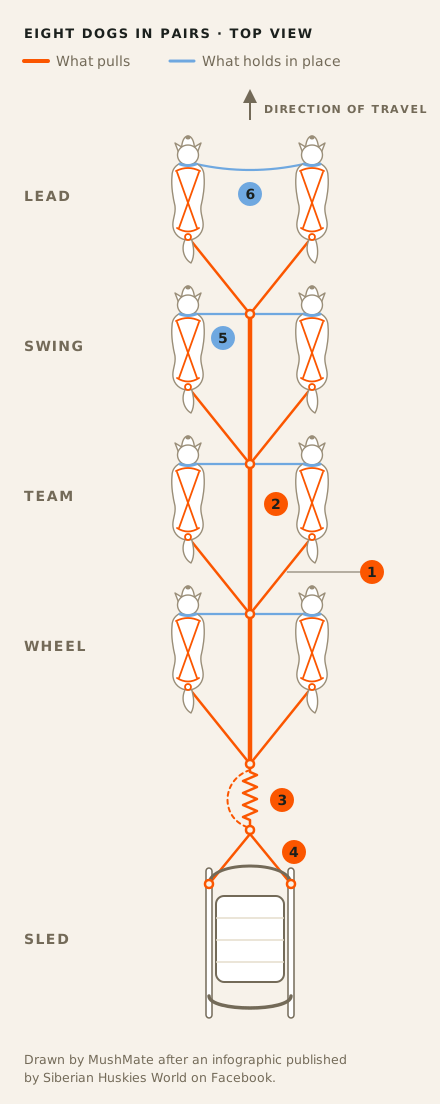
Drawn by MushMate, after the infographic published by Siberian Huskies World on Facebook.
Who runs where
A gangline reads from front to back, in the order of the rows on the Team screen:
- Lead — they set the direction and answer the musher's voice.
- Swing — right behind the leaders, they follow the turns and swing the rest of the line into them.
- Team — the power in the middle: they pull and hold the pace. A long line has several team rows (T1, T2…).
- Wheel — closest to the sled: they take its jolts and steer it into the turns.
What pulls, what holds in place
The diagram splits the lines into two families. In orange, what pulls, in the order the pull travels, from the dog to the sled:
- The tugline runs from the back of the harness to the mainline, behind the dog. One tugline per dog.
- The mainline runs down the middle, from lead to sled: it adds up the tuglines.
- The shock absorber, an elastic section, softens the jolts; a safety line limits how far it stretches.
- The bridle spreads the pull over the sled's solid attachment points.
In blue, what holds in place:
- The neckline runs from the collar to the mainline. It keeps the dog in its place; it does not pull — the harness does the work.
- Between the two leaders, a neckline joins their collars directly: in front of them, there is no mainline left to hold them.
In MushMate
- Rows follow the number of dogs. On the Team screen, a line always has a lead and, from two dogs, a wheel; swing opens from three dogs, team beyond six. Never more than two dogs per row: the team section grows by one row every two dogs.
- The place counts in the load. On a training run, the model counts a wheel dog as 20% more strained than at swing or team, and a lead dog as 5% less. These are starting values, not yet measurements — all the more reason to record the right places, and to correct them afterwards if needed.
What changes for you
- A « ? » at the top of the Team screen, next to « … », opens "Reading a gangline": the diagram, who runs where, what pulls and what holds in place, in the app's language.
- Offline too: the diagram is in the app, not on a server. It opens at a trailhead with no signal.
- Nothing shifts: the « ? » sits on the title row, and the sixteen dogs the screen promises stay visible.
What others see
Nothing. The sheet reads and writes no kennel data: it is the same for everyone, whatever their role, and nobody knows you opened it.
What it does not do
- It does not place your dogs. The diagram explains the places; it does not tell you which dog to put at lead. That choice stays yours.
- It only describes the paired gangline. A fan hitch has no places: the diagram does not apply to it.
- It always shows eight dogs. The diagram does not follow the size of your team; the screen does.
- It is not a rigging manual. Lengths, materials, snaps: none of that is in it.
None of this is "not yet": a help that composed the line for you, or redrew itself for every run, would no longer be a help for reading.
Choices made against the obvious
- Redraw rather than reuse the image. The simplest path was to publish the infographic as is, with a credit. But a credit is not a permission: the image belongs to whoever made it. We redrew it with our words and colours, and the credit is inside the image itself, so it follows the picture wherever it is shared. The original stays where it was born, on the Siberian Huskies World page.
- The screen's words, not the infographic's. Lead, swing, team, wheel: these are the rows you tap on the Team screen. A diagram with other words would have you translating just as you set off.
- A « ? » rather than a banner. A help shown at all times would have cost a dog's place on an already full screen. This one only shows up when you ask for it.
- Dark on the phone, light here. On the phone, the diagram takes the Team screen's dark background: no white glare in the middle of a field screen.
Thanks to Siberian Huskies World for the original infographic, "How an 8-dog paired sled team actually works".